信号模型
线性F-scan 信号模型
天线的频扫特征通过多个发射接收单元实现,每个发射单元发射相同信号,但各个单元之间通过TTD(true time delay)进行相移方式。以线性调频信号作为例子。每个发射单元发射的信号为
\[s_{ref}(t) = rect[t/T_p] \cdot e^{j(2 \pi f_c t + \pi K(t-T_p/2)^2)}\]其中 $f_c$ 为载频频率,B 为信号带宽,而 $K = B/T_p$ 。不同信号单元按顺序,以一定时延 $\tau$ 接连发射,则第 $n$ 个发射单元发射的信号为
\[s_n(t) = s(t) \otimes \delta(t - (n- \frac{N+1}{2})\cdot \tau)\]$N$ 为发射单元数量 ,以中心发射单元为相位,时间参考. $\otimes$ 表示卷积运算, $\delta(t)$ 表示冲激响应函数.
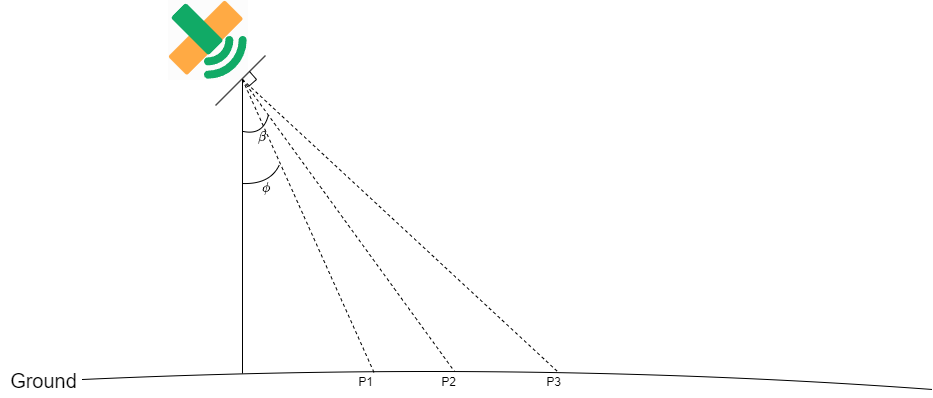
地面的点目标会发射所有发射单元所发送的信号, 也就是对所有发射信号进行求和, 设发射单元相邻单元的间距为 $d$ 光速为 $c$ . 则第 $n$ 个发射单元的传播时延为 $-(n-\frac{N+1}{2}) \cdot d\sin\phi / c$ , 总时延为
\[\tau_n = (n-\frac{N+1}{2}) \cdot (\tau - \frac{d\sin\phi}{c})\] \[s(t,\phi) = \sum_{n=1}^{N}rect(\frac{t-\tau_n}{T_p}) e^{j[2\pi f_c (t-\tau_n) + \pi K (t-\tau_n)^2]}\]根据系统参数,可以得到 $N \cdot \tau_n « T_p$ . 并将平方打开, 可以得到
\[s(t,\phi) \approx s_{ref}(t) \cdot \sum_{n=1}^{N} e^{-j[2 \pi (f_c + K(t-\frac{T_p}{2}))\tau_n - \pi K \tau_n^2]}\]后面求和式可以使用傅里叶变换与驻级相位定理求出,为
\[p_e(t,\phi) = \sin[N \cdot \frac{\pi (\tau c - d \sin \phi)}{\lambda(t)}] / \sin[\frac{\pi (\tau c - d \sin \phi)}{\lambda(t)}]\] \[\lambda(t) = c/[f_c + K(t-T_p)]\]所以总发射信号波形为
\[s(t,\phi) = s_{ref}(t) \cdot p_e(t,\phi)\]相应的设当前斜距为 $R$ , 算上传播时延,考虑到接收机也使用与发射机相同的频扫接收,则接收回波为
\[s_r(t,\phi,R) = [s_{ref}(t) \cdot p_e(t,\phi) \cdot p_e(t,\phi)] \otimes \delta(t - \frac{2 R}{c})\]参考文献
[1] L. Nan, G. Gai, T. Shiyang and Z. Linrang, “Signal Modeling and Analysis for Elevation Frequency Scanning HRWS SAR,” in IEEE Transactions on Geoscience and Remote Sensing, vol. 58, no. 9, pp. 6434-6450, Sept. 2020